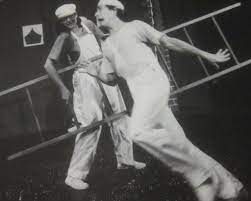
Photo: Ira and Kristen in slapstick acrobatic show Building Blocks
Part 2 : SPACE
Stay Put and Contemplate Evolving
SPACE
Conversation Thursday 28th May 2020
Welcome Dr Seidenstein back into our zoomland space today. Thank you for making the time to be here. Last time we delved into the first of The Four Articulations, which is BODY and the journey of discovering and encountering throughout your life, right up until your last breath, what it is to Be Only Directly Yourself.
Space is the second articulation.
My focus over the past couple of decades has been exploring what is possible within the space of creativity. Right now on my kitchen bench is a leaven that I will use to make sourdough bread and bagels. I put flour and water into the bowl, stirred them and left them. Every few hours I come back, stir and then leave them. After a couple of days I can visibly see this active life force at play bubbling away. It is alive. It is incredible. It is activating the Life force, and then this extraordinary process can take place.
When I do the creative exercises I feel this level of aliveness within myself. This vibrancy. This spirit. This awakeness.
Could you speak about this Creative Space within a person?
Ira: It’s a beautiful metaphor—Bread for Creativity. I know or am learning, that in my culture the significance of the bread and creativity is ritualised every Friday night with Shabbat. You have the blessing, traditionally over two loaves of bread. On one level that’s about creativity, the life of creativity. So as a person and taking off from where we were last time, you are meant to leaven, you are meant to rise to the occasion every day. When you and I are here together, we arise to the occasion of the different elements: your ideas and your concepts for this four-part conversation, and we share that, we share that creativity together. But the space of creativity is the place wherever we meet. The different elements can rise to the occasion; and within an individual, that thing is always bubbling, using your metaphor: always bubbling and rising.
It’s interesting there was a clown movement, not so many years ago, it was called RISE. Mainly it was Black-American young people. The structure was to hold a clown-dance competition. In different cultures there are traditional dance competitions. Sometimes there might be a circle dance and an individual might go in and do their improvisation or they might do their riffs, and bits, and their chops i.e. their best moves. So RISE was a clown movement and a very great one in fact. We talk about physicality, but those young people were completely in their Body. The space, well they knew exactly where they were in space plus the idea was to rise to their creativity. And they would compete and play. Part of the thing was that the better you get the better I become; and, the stronger I become, the stronger you can become. You learn through positive competition; resistance and challenge. Regarding creativity in my work, in the workshops, the exercises, The Four Articulations; people can do them at home, or in a park. Whether you do it in a workshop taught by me or others, those exercises give us a chance to be our body i.e. yourself, in space. And space is not only external; it is also internal. It is our internal combustion. It is that moving through space and the thing propelling us in space. Today NASA has set another space launch, which they haven’t done since 2011, so it’s nine years later, they launched the astronauts to the Space Station.
We are catapulted into a creative space every day. Each time when we go up to do an exercise we catapult ourselves into the space: the headspace; physical space of creativity. And that’s the performance aspect of it. And I don’t mean performance like for a paid audience. It’s a performance for whoever is there. It might be the teacher, the facilitator, the director, or whoever is there. Your colleague, or your friend. It might be no one, or a virtual someone like in zoomland that we all now seem to be in. It might be that you are just at home, in isolation, in quarantine, whatever you want to call this thing, and you do creative exercises for yourself. You perform it, even if you are just performing it for yourself.
You perform yourself by the way. A human is always acting. Like a cat. A cat has many different moods; it has a personality. Now, it’s acting quiet, and acting like it’s not looking, but it is looking at that mouse. The cat’s eyes are slowly blinking, but it’s not budging. So an animal acts depending on what it wants. And we as humans are the ultimate actors. Part of our nature is to act yourself. Even someone like the Dalai Lama, he has to act, he has to behave himself. He has to act like the Dalai Lama. He’s got a private name. He is a person. He has a role, which is titled the Dalai Lama. When he appears in public, he decides at any given moment, is he going to reply as himself, or is he going to reply as the Dalai Lama? One question might come to him and he might be the Dalai Lama. Another question might come to him and he might be himself. I mention him because he is probably a very evolved person. That’s a pun, as they are supposed to have past lives and stuff. The reincarnation is that he is the guardian of a particular lineage of knowledge.
Naree: He has had lots of practice.
Ira: Yes:):) He is a wonderful person, and if you read his second autobiography Freedom in Exile, its beauty is that he talks about himself and his humanity and he talks about the struggle with his role and the struggle with his family and their psychological makeup. He also talks about Tibetans. Tibetans were major warriors. They had an empire. That required a violent culture. Yet we all have the same struggles as individuals who may have evolved so to speak but in different ways. We want to pretend that science is the be all and end all, but ‘it ain’t necessarily so’. (“It ain’t necessarily so” is a famous song by George and Ira Gershwin. There is a fantastic theatrical rendition of the song by “Non-Clown Clown” Cab Calloway performed on The Ed Sullivan Show June 26, 1965
Tibetans have their own perspective on science and medicine, but the Dalai Lama also tells about the rituals involved when he wants to consult The Oracle. Even if you know theatre history we all think that ‘Oracles’ were an illusion created by the ancient Greek playwrights. Whereas the Dalai Lama’s Oracle is a real person who is uniquely qualified to go into a deep trance state during which he gives over his soundings and advice and wisdom. Until he passes out. Literally. And is carried out like a carcass – according to the Dalai Lama.
Naree: There are the struggles that we have as an individual and there’s also the struggles that we have within a culture. I just want to go back to RISE. I saw the documentary about that clown movement, and what struck me was that they showed some young people of African descent doing their moves. That film was about the culture over time and it showed these kids doing their dances that were actually so similar to these ancient dances that they had never seen. Yet the dance was in them. It was remarkable to see that expression. It was something inside their bodies that spoke of something much bigger than them.
Ira: So let’s come back to space. What you are saying, what I perceive from that, is that when the RISE people, let their bodies express themselves in space then unknown qualities within them, can and do begin to express themselves. Now some of those things might not be so positive. If less positive aspects arise in us, we have the chance to transform them. The same with your bread, you said you were making two different types of bread out of the one leaven: you are going to transform that material that has risen, into two different expressions. My understanding, my metaphor, to try and understand what it is that those young people of RISE are drawing upon from within themselves, but it is brought forth in space; and the thing you are making, the bread, the leaven, it’s going to grow, in space and then you are going to transform it, is that correct?
Naree: Yes. It grows, and then it keeps growing when you add in more flour. There’s a factor of time in there, you leave it, and it grows.
Ira: What I’m thinking also is that what you have within yourself wants to grow. It wants to grow like a tree, or a flower, like a plant. We are gardeners. We are the garden and the gardener so we can transform it in many different ways. Space, in my exercises is about what are you doing in space? What are you doing there? Then? What are you doing right there and now? What is it you are exploring? What are you exploring inside and outside? When we watch the artist, doing one of my simple exercises; what is the artist doing? What are they exploring? That’s up to them? I give these really simple instructions, a couple of steps to do. Although the expectation in the first instance is that you do those steps, what you do with that, or from that is up to you. What you do in space is where you do the steps and your exploration. Connecting to our previous talk about Body; your body is in space.
The Body of the Actor in the Space of the Theatre was my Masters Degree Thesis. I’m interested in that conceptual title and that’s part of my work, but that’s the beginning part. Next time we are going to talk about time and then the space-time continuum. The four topics are all interrelated. Let me just say something with that. Yesterday, I finally started to read the book by Maimonides, The Guide for the Perplexed. Maimonides lived in the 1100’s and he was a polymath. His many different abilities included knowledge in the fields of Maths, Science, Medicine, Astrology, Philosophy, Theology and related matters.
The Guide for the Perplexed is a conceptually dense book. In his introduction Maimonides explains that he has divided the book into many little chapters, and he’s done that to try and address many different topics; but he says don’t be confused by that because you have to see the thread that goes through all of that. That reminds me that in The Four Articulations where there are: Body, Space, Time, Space-Time Continuum, but the continuum going through us, going through us as people, going through us as creative artists, us as creative beings in space, in time, and the time-space continuum which we will talk about, has to do with our consciousness and our awareness. We have to see the thread.
Space is important: to give yourself the space, the chance to do, not just to think about something, but to do, to manifest, to do something. Space is really crucial and how you move in space communicates to the audience, to the viewer. Often I’ll demonstrate that even with just one actor near me in the working area. You’ll see me turn towards that person and then maybe take one step towards them, then I turn away, then I turn back to them, I take two steps towards that person. Now when you watch that on stage or in a studio those small directions become dramatic. It becomes dramatic tension. In other words, Space, how we move in space is really crucial to the whole of the performing arts. Is that a good introduction to space?
Naree: That’s a fantastic introduction.
If you were to use each of the letters S.P.A.C.E to create an acronym to
encapsulate this vast phenomenon, what would your acronym be?
Ira: Now an acronym is a game. When we make an acronym we are playing a game and an acronym is a metaphor, and has meaning because we play the game and give it meaning. So space I can say is
STAY
PUT
AND
CONTEMPLATE
EVOLVING
Stay Put And Contemplate Evolving. So that means be where you are, be ready to move, and your creativity will evolve organically and naturally. First of all, be where you are.
Naree: I laugh because I find being where I am is so hard. I have a tendency to get so carried away with an idea that I go off racing and I’m caught up in the excitement. I need to be really disciplined so that I can ground the creative ideas. I get so carried away that I almost miss the chance of what has arisen, going back to the leaven metaphor, something has risen and to really give space to what that is.
What do you suggest to help support this discipline of grounding ourselves & grounding our creative ideas?
Ira: One has to use their mind for the purpose of transforming their creative impulse. So rather than giving in to the creative impulse, the mind assists us to transform the creative impulse. You are using your mind with a great deal of willpower and focus. Rather than just paying attention to what the mind comes up with i.e. ideas, because it can come up with an idea every second. The question is what you are doing in space physically to communicate whatever it is you are thinking, feeling or exploring, or creating. What are you doing in space to express your idea? And what is it you are creatively involved with? Playing with and plying? Plying like putty. You shape it, you mould it, you stretch it, you condense it. What are you doing? And as you do that, you use your willpower to evolve that phase of the creation.
Naree: What’s coming very strongly into my mind is your Mime Exercise. The actor is physically set in place in space. I have memories of being in the workshop space and you really bringing our attention to what one’s hand is doing? What is actually going on in your hand? That awareness could be with any other part of your body. That discipline though is bringing the focus into noticing.
Ira: The noticing is the thing. More than what are you doing. It is the noticing and awareness that makes what you are doing alive or not. If you don’t notice it, it is not alive. You may think you are doing this mime wall, but if you are not noticing it, you are not with it, with your own experience of it. Thus it loses that psychic connection between the actor and the audience. So it’s not just physical. It is a mental discipline. The Mime Exercise, with the fullest of titles is called “The All-inclusive Mime Exercise, the Only Mime Exercise You’ll Ever Need for the Rest of Your Life”.
In that exercise, you stand with your feet wide apart, and throughout the whole exercise, you do not move your feet. You don’t even lift your heels. So you are grounded, anchored to that specific place in space. It’s not that when we do mime we have to stay on the spot. The important thing is that when you are standing on the spot; What are you doing? Not just physically but also psychically.
If we come back to the acronym Stay Put And Contemplate Evolving; Stay Put, in terms of Space, is really important. Stay Put, we also look at it as a metaphor, so it doesn’t necessarily mean standing still. That particular exercise the feet are grounded but we are not still. It is about stillness within. In other words, stay put with what you are imagining; stay put with what you are feeling. Stay put with what you are exploring; and it will Evolve. So it’s not that you have to stay put on the spot (except within the basic exercise), you have to stay put within yourself. It is the 4th Solo. Solos 1, 2, 3 involve walking i.e. moving in space in three different concepts. So The Mime Exercise is the 4th and the first located on a single spot. Whereas the last three Solos combine moving through space and involve moments on a spot. Those last three of The 7 Solos also introduce the geometric importance in theatrical space in use of Directions. At least one major teacher of Directing in Poland insisted on the study of Geometry as part of the knowledge. Poland by the way gave us several of the most potent Theatre practical philosophers, namely: Tadeuz Kantor; Jan Kott; Jerzy Growtowski; Henryk Tomaszewski.
The 6th Solo that is: The Six Directions Exercise stems from Indigenous shamanic traditions that teach/remind their community about the basic premise that we Humans exist in Space. We have teachings and practices related to 6 directions in the Jewish Culture. The most obvious applications of Directions, for example, occur in the movements incorporated into the important “The Amidah” blessings; and, The Mourner’s Kaddish.
“…bow the head forward, and remain bowed until the word that ends with the same symbol, then raise the head. Before the final paragraph of “Oseh Shalom…” one takes three steps back, and upon concluding the Kaddish, three steps forward. It is also customary to incline the head right, left, and straight ahead, while reciting certain words in this paragraph”. (R. Zalman Goldstein.)
Now let me put that another way which is, because we are talking about space, every movement in space counts, because the audience sees everything and reads everything in your body language. So if you, the performer, is not aware of moving to the left or moving to the right, (“and let’s do the time warp again” Rocky Horror Show), well everything in the theatre, in performance, counts because the audience sees everything. The word from the Greeks for theatre said to be ‘theatron’ means a ‘seeing place’. The Greeks ‘saw’ in an amphitheatre in a semicircle of seating divided into pie-like sections.
Naree: The place to come and see.
Ira: Amphitheatre. Theatre. And I’m also reminded of an auditorium. That is not Greek but Roman. The auditorium refers to hearing. The auditorium was to see, but also a place/space where you hear and the theatre, theatron is where you see and also hear.
My view and method suggests that if the actor understands that the audience sees, and works with what they see, then the audience will hear better.
When I’m directing Shakespeare scenes or the few times I’ve directed a few of the plays, I prefer that the actor makes a small movement just before they speak, or at least move slightly just as they begin to speak. Because of the difficulty of the language, sometimes an actor does have to stand still while the other actor speaks, because otherwise the audience won’t hear so well what the actor is speaking.
Often actors are told ‘don’t move while another actor is speaking’, I don’t agree with that generally.
There is validity for stillness obviously, at times, for the actor especially in a text laden play such as those of Shakespeare. However, I shape the actors movements so they know their movement is supporting what the actor who is speaking is saying. Importantly, sometimes there does have to be that stillness so that when the other actor speaks the audience sees them speaking. But before we speak, we need to make a slight movement so that the audience’s eye will come to us, and then as we begin to speak, they will hear it better from the beginning of that passage of text.
Naree: When you say ‘see’ , for the audience to see the actor, are you just talking about the physicality of seeing? Or a feeling that is generated when we see?
Ira: Both. I was particularly talking about physicality. If we understand the audience members are seeing, if we move consciously they will hear better, if you are dealing with spoken performance.
Naree: Just taking a pause here. Giving some space. What I really like about the acronym ‘stay put’, is that it is not ‘stop pause’. There would be a different feeling: Stop. Pause. But stay put, there’s a settling. There’s a chance for things to settle, and for you to come into a process of digesting the creative idea, and then evolve it, or it will evolve itself, using the tools that you bring to shape it.
Sometimes when an actor is working creatively they come up against all manner of blocks. There are internal blocks and there are external blocks. How do you move through creative blocks and evolve?
Ira: What comes up for me when you ask that question is the difficult times I’ve had, particularly being on contracts and working with other performers or directors or choreographers, in other words, collaborating with other human beings; is that it’s challenging. One isn’t always successful in meeting that challenge. Some people would say they have no problem, well there is just as good a chance that type of person may in fact be one who causes problems for other people? They are the cause of the outside force that the other person is having to cope with or deal with. I think that it’s a natural state that we are trying our best to cope and create. So the outside force I’m saying can often be our colleagues, even with not an ounce of malice intent from them. The people closest to us in life at that moment are our creative colleagues. It is a pretty profound relationship. It is the essence of intimacy and thus is a sensitive and vulnerable process. This is so exceptionally portrayed by Shakespeare by the characters of non-professional actors in A Midsummer Night’s Dream including all scenes in which the character Bottom appears (Bottom as in Ass, as in the wannabe actor or clown also being the biggest ass).
Yet it is the very combustion of the elements, coming back to your bread, the combustion is what gives the creative dynamic, and that gives life. Let’s take someone like Jerry Lewis, he was an extraordinary clown; he was known to be a difficult person; but he was also known to be an extremely generous person in most situations. In other situations he may not have been? He had a really great knowledge about clowning, his elders in Clown, and film making; but he would have people around him and he might need them to give him ideas that he could reject so that in the rejection of that person’s suggestion, out of him, out of Jerry, emerged the solution. Whereas, if he was just on his own, he might not have the best or the right solution, until that person provoked.
In truth he did both i.e. he was extreme in his talent for writing scripts, screenplays including directions yet he also always worked collaboratively on the floor i.e. in the actual filming and setup processes. Additionally, more than nearly any actor I have ever seen, Jerry Lewis worked on screen with the ultimate harmonious intimacy. As an actor he was extraordinary in that regard. He was also exceptionally in tune with the actors he directed, including the select few actors who worked with him numerous times (in addition to his most exceptional Clown partner – Dean Martin). Two of those who worked with Jerry in a number of films and had great duet scenes with him were Kathleen Freeman and Buddy Lester.
An interesting thing about co-creating and the dynamics of creativity is that the internal challenge is always there. Often the issue is about just what to pay attention to, what’s going to yield the result, but you don’t know, that’s what you are experiencing. Even if you were Chaplin, who again was an amazingly creative clown; plus he was a master filmmaker. He was very advanced. Like the Dalai Lama, he was a very advanced person in many ways. That doesn’t mean he was perfect. In the Dalai Lama’s autobiography he explains that he is not perfect. He has problems that he’s dealing with; he has challenges that he has to face and to make decisions about. All of us have to face those things, that is what makes us a performer, in spite of all weaknesses, you do it.
But also we put ourselves in the situation where we are going to be challenged and we know that out of that we will emerge better. It’s the same as when I swim my laps when I do my swim training, I call it the combat zone because it is such a mental challenge to just keep going. Your thoughts pop up and it’s just you and the water, you move along, you’re moving along fine and then all these funny thoughts often come up. If I say today that I’m going to swim 10 laps yet suddenly 8 is ok; or if I’m going to do 30 today 20 is ok; I don’t have to do 30. All such funny thoughts; should I kick harder, should I pull faster. They are not at all continuous but when they arise suddenly I think ‘oh no not you again and I refocus on my combined task of reach, kick, breathe. Because of such thoughts including the necessary technical ones I call my pool training which I love, The Combat Zone. Not because of the physical challenge, that’s not the real challenge, the real challenge is the mental zone.
It is the same when you do a creative exercise; what mental zone are you going to pay attention to that is going to yield your best creative self? And it is a challenge every time; for me or anyone because there are so many options which appear. You have to learn, you have to hone your concentration, you have to hone that ability.
Naree: And that’s the discipline of showing up to the combat zone, whether it’s the swimming pool or the rehearsal space, or the kitchen. You show up to the best of your capacity.
Ira: We had this guy on TV in the United States, and h was like a ‘Mr Discipline’ so to speak. His name was Jack LeLanne. He was a fantastic and enthusiastic man. He was like a clown except his field of expression was physical training and he was great and very inspiring. So he gets my highest accolade: he was a Non-Clown Clown. LaLanne was the most disciplined person anybody knew of and he said “Life was one big battle, you against you.”
Here is an insert, a quote from Jack Lalanne: “Dying is easy. Living is a pain in the butt. It’s like an athletic event. You’ve got to train for it. You’ve got to eat right. You’ve got to exercise. Your health account, your bank account, they’re the same thing. The more you put in, the more you can take out. Exercise is king and nutrition is queen: together, you have a kingdom.” Jack LaLanne.
Naree: Yes. You against you….. But sometimes there are battles with people and situations, and they can be so tricky,
In one area of my work, is creating with people living with disabilities who are labelled as having disabilities. I have found one of the biggest obstacles is the limited views and beliefs from other people. The limited views and the belief systems, that’s the disability. People believe that the world is a certain way and they don’t, or can’t move on from ‘This is how it is’. I have seen that the real disability is the set, locked view of reality. I tend to see potential and poss-ability and as a result of this, I see extraordinary things occurring. Over the past ten years I’ve seen glorious expressions in human beings and it’s just through the kind of space that I have created, co-created with them.
How do you work with the challenge of blocks that come from this type of Rigidity?
Ira: One of the things as a teacher and director, I have myself in a light trance state, where I trust that each person in front of me, the actor, that they are the living embodiment of goodness; and everything about them is good. Now if I think about this person or that person or this thing about that person, well they’re not all good, they have imperfections; but part of their good, is their imperfections.
I think last time we talked about the idea of the word ‘perfect’? I have trained myself, especially in the working situation, working creatively on the floor, in the studio, that I look at people as if they are good, they are goodness. A good person. This is also connected to the quantum physics idea; and I’m not at all a scientist or mathematician, I’m certainly not a physicist but I read about Quantum Physics in books written by scientists for us laymen who do not understand science professionally speaking; but we can read and understand an idea and a concept. Quantum Physics found or claims that the observer affects the observed.
In other words depending on the observer they could affect the particle (or person) that is being examined. So my state of mind as a teacher and director can affect, and I’m pretty good at thinking of people as goodness. Also not judging people but if there is something that comes up that I need to correct, or help to point out to improve, then I do that. It just comes up and I go oh what’s that? It’s quite mechanical to me, quite mathematical to me. It’s not a judgement. “OK, you’re leaning to the right, actually I wanted you leaning to the left. But because it’s my right, which is your left, we got a reverse image.” It’s not their fault, what I was wanting was simply the opposite direction. I learned that approach from a director of TV commercials.
That was in New Zealand, one of my first commercials as an actor. I had done the audition, got the job and I showed up at the appointed place, a commercial TV studio. It was the director’s own company studio. It was the director who greeted me at the door, and he showed me around. It was only him. No one else was in the building. He knew how to do the lights, he had built the set too. This guy could do it all. Actually initially he wanted to build the same gag that Buster Keaton made with the front of a house falling ‘on’ him as he stood stone faced still. He was on the spot and the open door passed over him. One of Keaton’s most potentially deadly stunts. The wooden house front weighed about 2 tons and there was no room for error in the measurement of where the door frame should pass. In theory, I was to be the first person since Keaton to do that exercise. As an ever underemployed artist – beggars can’t be choosers. Fortunately the director had his own doubts so he built a more standard set for me to romp around on rather than a set house front potentially falling on me. Maybe that Keaton gag was repeated by Donald O’Connor in the movie The Buster Keaton Story? Though by that era new safety equipment could be arranged.
Because there was only 1 actor, my Director didn’t need anyone else except me and him. It was remarkable. Usually when you go to do a commercial or any screen work, there’s the makeup person, and the caterers, the costume person, light, sound, gaffer, many people. This was one person who made this commercial. He would tell me what to do as an actor. When he would correct what I did, I would say ‘sorry, oh ok I will go that way’ But he said “No you didn’t do anything wrong, I did”. The director added “Ira, I have this philosophy about directing, that the actor never does anything wrong, it’s my directions that I have to improve and change to get the actor to do what I want.”
That is a really incredible idea. When I sit as a director or teacher, and sometimes I’m up on the floor too because I’m choreographing, maybe working directly with the individual or group; and still In my mind I’m actively focusing on the goodness of that person. Not thinking so but such a thought is planted deep within me. It was a teaching from my Mother. Yet I look at the actor coldly i.e. What are they actually doing? Not judging about their action or acting. Rather looking mechanically like in a science experiment and simply asking what is the actor doing physically in terms of acting.
Sometimes if I don’t know what they are doing, I’ll ask them. If they do something really off the wall that doesn’t make sense, I’ll ask them, what were you doing? What were you thinking about when you were doing that thing? Then when I can understand their thoughts it becomes easy to find a way to move forward in the creative process. Often I will proceed to support, shape, and frame their idea or instinct to make it work. As one actor, Tim McGarry said to another actor when I was directing the play The Suicide (by Nicolai Erdman): “You have to be careful what you suggest to Ira, because he’ll do it”. Tim is now a veteran and gifted Director and Dramaturg and he happens to be one of the Patrons of I.S.A.A.C. (International School for Acting And Creativity).
I think as a teacher, as a director, we can improve our consciousness about the person we are working with. Yet, people I have worked with know that I can be very strong, they might say hard. I’m never against the actor, but they might be against themselves. When I say I want you to the left, that’s what I mean and I insist on that, and I might not be able to explain straight away why left rather than right. I may not know why yet as it may simply be an intuitive sense. I’ll be very insistent though. I’ll say left left left, or even shout a little bit, but this is the same as a sports coach, you use your vocal energy to provoke the power within the person you are assisting. It’s not pussy footing around.
Naree: It’s that really positive energy that enables the creative spark to rise, to gestate and move to its next place of evolution. I’m reminded as you were speaking about goodness. I’ve heard you many times, within the space, say to people “You are already good. And what we are doing here is seeing what gets in the way of your goodness.”
Ira: And I’ll also say, “You’re already good. The question is how do you get gooder?” That’s my quote. It’s bad English, but it’s got the right idea.
Naree: What’s so powerful about that, the positive energy, is that it changes what can happen in space.
Ira: Absolutely. No question.
Naree: When you feel judged or judgements, it causes a restriction. It causes blockage. But when you can put those ingredients, those elements there that allow the goodness, that allow the pure creativity to start to reveal itself, it’s very powerful.
Ira: Also, you have to be very careful with this because we start to think it’s some altruistic lovey dovey atmosphere, which it’s not. It’s a fire cauldron, it’s a bubbling cauldron of creativity. It’s not about pussy footing and it’s not even about idealism, it’s about ways in the mind that can improve the space. They can improve the energy in the room.
It can be very forthright. I worked in Holland a few years ago. I did a collaboration with a dance company and their director and choreographer was wonderful, a person named Kristel van Issum. Her company was T.R.A.S.H. Dance Theatre. The Dutch are fantastically upfront in their communication. They would die in Australia; they would kill everybody in Australia. Australians think we are really upfront, I don’t think so or maybe a different way of being upfront? But let me tell you, the Dutch are upfront. They are really great to collaborate with as they say what they actually think. And then you can say, I don’t agree. Then you can discuss it together and you come up with a solution. They are very forthright and tremendously creative people.
Let me come back to the original question which was about internal and external. I think that as an actor, each of us is our own worst critic. It’s not the director. It’s not the teacher. It’s not even the other actors who may or may not be nice people to work with. It’s our own worst critic that we have to struggle with because artists, you can say, are rather sensitive in certain ways. Also they are vulnerable. When you are creating, you don’t know, you haven’t finished the product, you haven’t finished the work yet, so you are vulnerable and that means there are questions. That means we question ourselves. It’s not wrong. It’s not bad, but there are better ways to deal with ours and others questions, and there are less better ways.
Naree: This vulnerability; linked with that is fear of the unknown.
How do you say we can approach our life and our creativity with more courage?
Ira: I’m a person of faith. So the question is what do you have faith in? I have faith in the Universe. I have the faith that things are unfolding, and they may possibly be the opportunity to bring clarity and light to the next situation? It doesn’t mean things are perfect; they are moving. I’m not sure if that answers your question, but you have to learn to have faith. I think in Hebrew the word is ‘emunah’. People don’t realise that with that Culture; to call it a religion is not quite accurate or not complete. The Culture is a practical or living philosophy about understanding the human nature which includes the body, in space, in time; it includes the psychology, the emotion, the feeling, the awareness, the sensitivity, the breathing; the relationship that we are all one we are all part of GAIA, we are all apart of earth, Earth, biosphere, with and within the cosmos. One has to have, and one has to nurture faith.
The question is, faith in what?
“…Yet the greatest vitamin you can provide emunah is plain exercise. In fact, an artisan is called in Hebrew an “uman”—because he has practiced his craft repeatedly until it becomes natural for him. So too, emunah grows taller and deeper as you accustom yourself to see all the phenomena of life as manifestations of the Creator’s presence and glory. All the more so is emunah enriched by being tested and withstanding those tests; and by making sacrifices in life for the sake of your emunah…” (R. Tzvi Freeman.)
I don’t have any faith specifically in politics; I have faith that politics is part of the biosphere i.e. it’s part of reality. I don’t have a problem with the strangeness of reality. I’m not going to put my faith in politics per se. Politics is part of the human unfolding; the human experience. I think in the future, one has to learn how to nurture faith in something beyond the pettiness of politics. Faith in the big something that we are not in control of? Today, this morning I went out and I heard the garbo and his garbage truck, and I hadn’t set the bins out and we have a few people who live in this multilayered household, so I got up, whatever time it was, and I put my shorts on and my sandals and went outside to make sure the bins were out and there was a magnificent, radiant, red sky of the sunrise. O.(h) M.(y) G.(od). I couldn’t believe what I was seeing. The Sun will rise tomorrow. The Sun WILL rise tomorrow. We may not see it; we may not be up in time, it might be cloudy, it might be raining, but the Sun will rise. RISE. Remember that clown movement? We’ve come back to rise.
Naree: Coming full circle.
Ira: The Sun will rise tomorrow. And in terms of when we get into a situation, a pickle, it’s difficult being a person, it’s difficult being a social, interacting being. It’s not because other people are difficult, it’s difficult to deal with the complexity. So it’s a challenge. That’s not going away. But faith helps you to understand that it’s a challenge right now and it will wane. The Moon will wane. It will wane and it will be better. We as people can help to bring light to a situation. We can be like a sunrise in the next moment. We can’t always do that, and sometimes there’s nothing you can do about a situation.
Om Mani Padme hum along kids…or whatever it takes to get you or me through a challenging moment.
Naree: Sometimes, the only thing that can be left to you, is to walk away..
Ira: Sure
Naree: That’s part of the mix
Ira: You have a range of options, but it doesn’t make it any easier.
Naree: The final part for today, I was playing around with the letters of the word scared. I write down words and i look at letters and I move them about because I find that there are complex meanings, so I wrote s c a r e d, then I moved the letter ‘c’, to a different
position, and discovered that the word was now sacred.
To your mind when does something become sacred?
Ira: It’s already sacred. We don’t necessarily see anything as sacred or see it as such but everything is sacred. It doesn’t mean everything is a ritualised holy thing but everything is sacred. We don’t always perceive it that way.
When a person in a workshop is standing on the floor in front of me and others, we bear witness. We witness their sacredness, that is: their struggle; we witness their humanity; their creativity; their intellect; we witness their humour; what emerges from them. We witness our own reception of them. So the whole experience is sacred. Now you can move that up and down on the scale of more sacred and less sacred, but that is not so easy to define.
In my workshops, it doesn’t always happen, it might not happen in 10 workshops in a row, but it does happen frequently, that something happens to a person that is sacred and we witness it. In reality, the ‘it’ happens not only 10 workshops in a row, but, it would be most unusual if ‘it’ doesn’t happen in every workshop including as reported from others who are teaching The Four Articulations.
Now we might not all think about it in the same way, but I can tell you that I’ve had it happen many times that we’ve witnessed something from another realm, that’s just taken place, we’ve gone into that sacred zone, or the artist has and we’ve witnessed it, so we’ve shared it. Now that’s transformative, but whether the person captures it or understands it, that’s another matter. It happens regularly in my work; and I don’t always call it out, I rarely call it out. Sometimes I will, but that’s actually what we’re dealing with, which is that the work is sacred, or any work that a person does in any profession has the potential to be sacred. Humans are sacred. Life on Earth is sacred. So when you put humans together in space, the space becomes sacred.
The specific exercise for us to learn how: to bear witness; to be a quantum observer; to be a supportive yet passive colleague as an audience; is The Whisper Exercise. That is a quartet exercise. The quartet is a ‘secret’ in Clown which we can observe in an abundance of USA TV comedy shows from: I Love Lucy, Sid Caesar (several TV Series), The Honeymooners, The Carol Burnett Show to All In The Family, Sex In The City, Golden Girls, Seinfeld. Additionally in the ‘clown secret’ category and in the book of that title; I include the Writers and Directors of those comedies just mentioned and an enormous variety of shows which occurred chronologically in between those mentioned.
Now I don’t want to make ‘sacred’ bigger than it is, because that’s different from the performing arts. Otherwise what we’re discussing becomes a church, or a mosque or a synagogue, or a temple, It all becomes this googey-boogey stuff. That’s not what I’m really saying; I’m saying the opposite, which is that wherever we are is sacred in that it’s alive. Like if you go into a forest or the bush or a jungle, it’s alive, there are all these ants and little creatures and birds and reptiles and animals of all sorts might be there, it’s all happening. It’s not a nice paint job, with everything in perfect, harmonious balance: the balance is in the wildness, that’s the nature of the artistic studio.
Recently I saw some photos of Francis Bacon, the avant-garde painter (1909-1992). Those photos showed his art studio, you can not believe the layers of stuff and paint, you can not believe his creative mess. But if you go to another artist’s studio everything may be the opposite i.e. in perfect order. Like Norman Lindsay’s left intact at Faulconbridge, NSW. Likewise Bacon’s studio exists as it was but relocated to his birth area of Dublin. “Bacon once said that he’d never come back to Dublin until he was dead” (Brian Clarke sole executor of Bacon’s estate).
I think the sacred is everywhere. Also we can be scared of the sacred, because the sacred can touch us, it can make us cry, instead of being strong. Reminds of Oona Doherty’s works of dance-theatre; and one named as such: Hard To Be Soft. Rather being vulnerable and soft is part of our fear and our fullness. To experience that vulnerability in life, is where your strength is also, to go wow, life is really sacred and vulnerable.
Naree: Robust.
If I bring it all the way back to the original spark, the leaven for the rise, a really good leaven that captures the wild bacteria, it will enliven and enable a really rich, luscious, robust hearty loaf of bread.
Ira: If I’m not mistaken, it’s the bacteria, and the air plays into it? The air is all part of it too.
Naree: Absolutely.
Ira: The ambience. The space has an ambience.
Naree: It does.
Ira: Through our consciousness, we can shift that bacteria, we can shift that space. How’s that for today?
Naree: Fantastic.
Parts 1, 2, 3, 4 below:
Part 1 Body
Part 2 Space
https://iraseid.com/2023/06/what-does-a-clown-know-part-2-of-4.html
Part 3 Time
https://iraseid.com/2023/06/what-does-a-clown-know-part-3-of-4-time.html
Part 4 Space-Time Continuum
https://iraseid.com/2023/06/what-does-a-clown-know-part-4-of-4-space-time-continuum.html