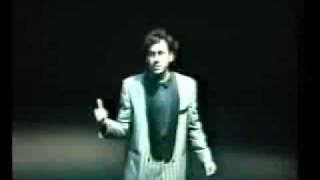
photo: Ira Seidenstein in Harlequin Dreams – whole show 45 minutes on youtube
The 2-Hands Secret to Acting and Clowning
One of my shortest blogs – just a few points about the value and secret of the hands in performance. How that secret is openly taught and embodied via the individual within The Four Articulations for Performance.
A) I have located three basic and essential uses of the hands in performance.
a) seeminly non-active use – the hands appear ‘passive’
b) active energized use of the hands, but, not in formal gestures
c) active, formal use of the hands in formal gestures and/or strong physical actions
I began to use a, b, c during my 2 years job as an Art Model for tertiary level art courses. I discovered a number of other such ‘secrets’ during my job which seemed to involve primarily be still, motionless. Seemingly doing nothing. I was actively still. In the stillness, like a cat, I was attentive to the consciousness of experiential research.
Via that job I fell into the Theatre. An art student name Sandy majored in Theatre and desparately needed a male for the two-hand one-act play “Telephoney”. Sandy’s teacher Trudy Scott assigned a project of political theatre via published plays of guerilla theatre.
B) I had already discovered how to create in 360 degrees while being stationary. Acting was only applying that discovery to moving and speaking. As Noel Coward said of the secret of Acting: “Say your lines; and, don’t bump into the furniture”.
Sir Laurence Olivier advised a sweating, panting, Dustin Hoffman when they were filming “Marathon Man”: “Try acting. It’s easier.”
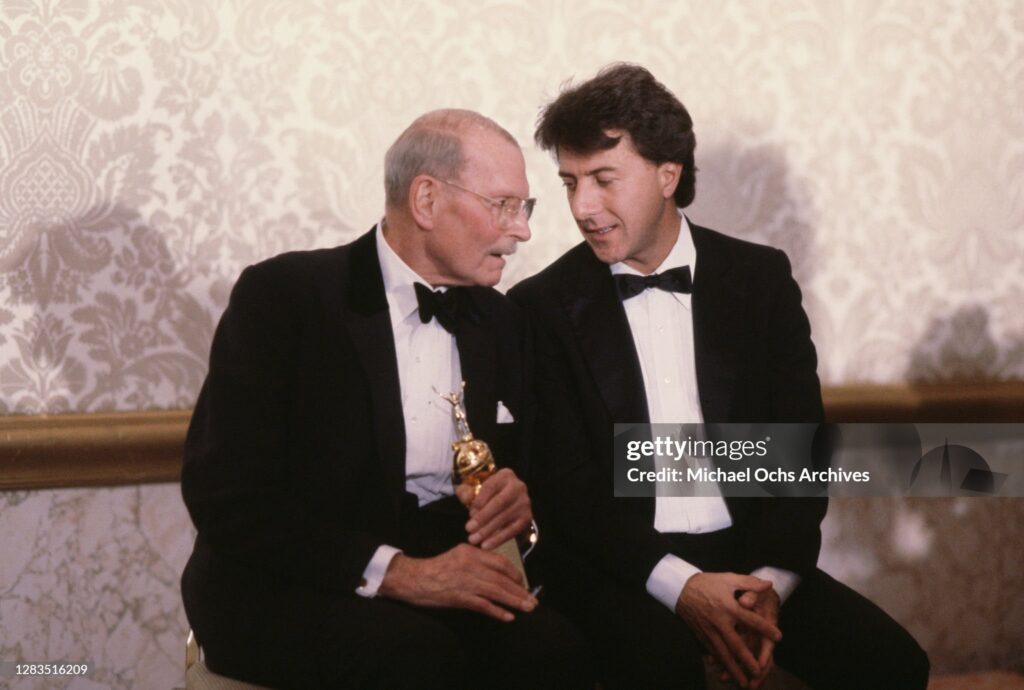
On the other hand, Olivier was an excedingly gifted and vivacious physical actor. He wrote the Foreword to Stage Combat: “The action to the word“. In the foreword Olivier listed all the horrible physical accidents and operations which he experienced himself during his lifetime as an Actor.
During my 2 years as an art model I was studying Liberal Arts. I was interested in fitness too. I went to a bookstore to find a book on fitness.
C) Two books struck my interest and I bought them and began training that day. Both were in Asian martial arts. Both were instuction manuals. One was for a 20 minutes routine of Tai Chi Chuan. The other was the 4-minutes exercise plan of Mao’s industrial revolution. Millions went from an active rural life as farmers to factory workers who needed a fitness regime. In truth it was a fitness to fascism regime, regime. Both manual’s method involved various uses of the hands during each part of the 20 or 4 minutes regimes.
Very soon I was able to teach the 4 minutes routine.
D) I also began to create my own 10-minutes, 10 movements training choreography Core Mechanics. Within Core Mechanics I placed a, b, c uses of the hands and fingers i.e. passive, active, gestural.
However, with Core Mechanics movement #6 I placed The 2-Hand Secret to Acting and Clowning. That is to ensure that the performers hands or in this case arms are at least some of the time doing 2 different things. Within that specific exercise at one point the arms cease working parallel and the same action. Instead, the arms are then momentarily – one arm bent and one arm straight.
I can not stress the value of that secret and technique for performers, actors, and clowns.
Then throughout the following section Core Mechanics, in all creative exercises one is discovering for oneself the value of a,b,c passive, active, gestural AND using ones arms and hands in greater natural variations based on left arm/hand doing a,b, or c while the right arm/hand are doing a different a,b, or c.
For example if left is doing a, then right may be doing b, or c. If left is doing b then right is a or c. If left is doing c then right is doing a or b. That is placed and tested within all of the creative exercises.
Eventually Core Mechanics was one section of five more sections comprising the larger template – The template is The Four Articulations for Performance.
During the period when I was creating Core Mechanics as well as my preliminary creative exercises; I was reading a flowing variety of books. Some were a few autobiographies of golden era actors and vaudevillians. Several said that the ‘hardest thing to learn/discover was what to do with your hands in performance’.
As mentioned above at least via modeling, and my two manuals, and creating my own method The Four Articulations – I was on to this ‘hands thing’. Core Mechanics as said includes an integration of the hands as passive, active, or gestural.
E) However I was also reading books related to esoteric arts starting from my tai chi manual. In some book i read a bit about Leonardo da Vinci’s Vitruian Man design inspiration. Movement #6 in Core Mechanics incorporates varying use of the hands.
F) After Core Mechanics all of my creative exercises encourage one to test, sample, adapt, and apply the three basic uses of the hands – passive, active, gestural. As integrated to the whole body head to toe including hands and fingers. The people of those autobiographies that I read would have approved. They were my inspiration. Along with Da Vinci, tai chi, and my discoveries during stillness.
G) My own clown creations including my first clown act that I began to perform every weekend for a number of months was a holistic experiment with my discoveries as well as things I learning in a semi-formal way albeit “a la Italiana” i.e. as the Italians do it “a la improviso” as my teacher of theatre/mime/Commedia dell’arte, Carlo Mazzone-Clementi, provoked us to discover for ourselves. Which I took to heart and literally. I was prone to know my a,b,c of Hands incorporated to everything I did in performance including during creation and rehearsal and my own early morning training.
Of course, the world of Veda including Yoga’s “mudras” or ‘hand gestures’ are said to trigger or invoke many different aspects of our consciousness. There is method to their madness.
Whereas, I was more inclined to explore a la Italiana.
H) That is, until, a few years passed and the great theatre scholar Mel Gordon produced a book of his years of research titled Stanislavsky: The Russian Years. In that book he relates a landmark private experience of Stanislavsky’s prodyig Vahktangov who was assigned to Direct the first Hebrew production of The Dybbuk. The Dybbuk was a play written by S An-Sky. An-Sky wanted to preserve the folk tales of the massive Yiddish speaking communities spread throughout the region known as The Pale where Poland, Russian, Lithuania, Latvia, Ukraine meet. An-Sky collected about 1400 Yiddish folk tales and he amalgamated them into a single play. The Dybbuk was about an esoteric pact between two Jewish men who together studied the mysterious Kabbalah.
Famously The Dybbuk, that production with the amateur theatre group asked Stanislavsky to direct. Which he declined as he deemed it more appropriate for his prodigy who was ethnic (well partly as his Father was Armenian) would better understand the Jewish culture.
Vakhtangov did not understand.
Specifically he did not understand why the amateur Jewish actors had to use their hands all the time.
Until.
Mel Gordon related a lot in his lecture about his research into The Dybbuk. I attended that lecture in Berkeley, California around 1978 or 1979. Gordon knew that according to legend in modern theatre, The Dybbuk was known to have a mystical aura in and around it. If nothing else, there were quite a few dramas in the years of producing the final script and leading up to the first productions. Gordon being the great researcher proceded to travel to meet each of the then, in the early or mid-1970’s, actors from the earliest production(s) of The Dybbuk.
Amongst the dramas, during the 2nd production’s rehearsal, its director Yevgeny Vakhtangov fell ill. He needed to go and stay in the hospital for at least a few days. This led to one of modern theatre’s most obscure breakthroughs. About how essential the use of one’s hands are when acting.
As Gordon relates it in his book Stanislavsky Techinque: Russia – Vakhtangov was assigned to share a hospital room. There was an older man also assigned to that room. The old man being a local had quite a few visitors. Mostly Jewish visitors as the old man was Jewish. Vakhtangov saw that each and all of them, visitors and old man, constantly used their hands when they talked. As you know, Italian, African, Jewish and some other Cultures use their hands animatedly whenever they talk. And those Cultures usually don’t just talk. They parry and patter, natter and chatter, and charge and chortle, and giggle, and gasp, and sing, and zing – theatrically. Whereas Vakhtangov being ethinically Armenian nonetheless was led to believe that good acting is reserved by its professional standard of good taste.
His actors of The Dybbuk likely, like all amateurs, really want to be professional, but their instincts are more pure. They can’t help but to be just who they are.
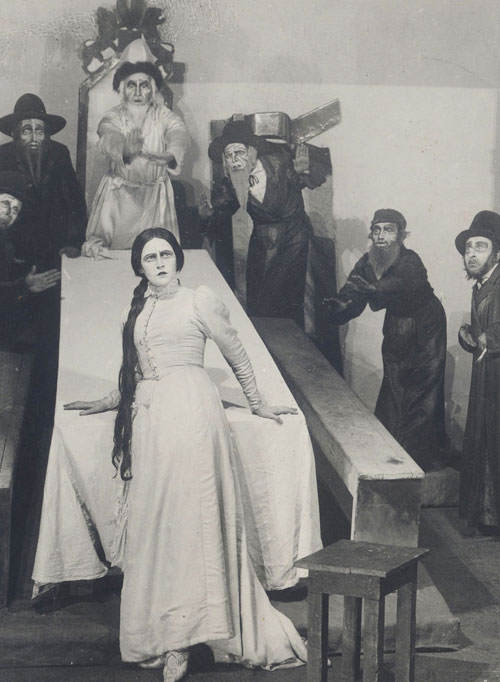
photo: The Dybbuk – Hebrew language production – Habima Theatre in Moscow 1922 directed by Vakhtangov
For the Jewish culture their instincts for theatre are ‘Talmudic’ i.e. ancient. And well oiled via the cultural practice of arguing, discussing, kvelling, kvetching, and putzing around. And around. And once again if the laughs keep coming. Whether at a funeral, a wedding, a street corner, a hardware store, or around a kitchen or dining room table. For people of many cultures those locations are all stages. So why not use them and perform whatever you have to say rather than just say it.
Vakhtangov saw from his hospital bed, synchronistically, that his Dybbuk actors weren’t bad actors. They weren’t just Jewish amateur actors. They were also the carriers of the secret of the importance of using one’s hands, constantly yet in varied ways such as a,b,c – passive, active, gestural. The real way of communicating is to tell a story. While you’re doing that you may as well use your whole body including hands and eyes and the numerous muscles in the face!
When he went back to Stanislavsky’s Moscow Art Theatre Vakhtangov was ready to transforme Modern Acting via his Vakhtagov method. Famously Vakhtangov and his method encourage the actor to act out the idea of a scene rather that work on the scene’s text verbatim. The actors act out a la Italiana (improviso) to get a feel for the scene and drama. To step into the character’s skins.
Last snippet regarding The 2 Hands’ Secret to Acting and Clowning I came to yesterday.
But that was preceeded a few days ago when I was working long distance with an I.S.A.A.C. Associate. We are processing his solo mime/clown show. We work via zoom, emails, videos etc. 2 sections we were looking at a few days ago. In several spots I provided a few very specific written notes. In particular a few of those were specific adjustments in the use of the hands. My notes involved a,b,c ie passive, active, gestural. Plus in several cases a differing use of one hand as opposed to the other hand.
THAT is a hidden technique within Core Mechanic‘s Movement #6 one of my two Vitruvian Exercises. THAT technique is to differentiate the way an actor/clown uses one hand versus how they use the other hand at the same time.
THEN what I came across was an article regarding Franz Kafka’s inspiration upon seeing and meeting with a Yiddish Theatre troupe. The article is linked below. The article includes a few quotes from Kafka’s Diaries – 1910 to 1923 as compiled and edited by Kafka’s close friend Max Brod
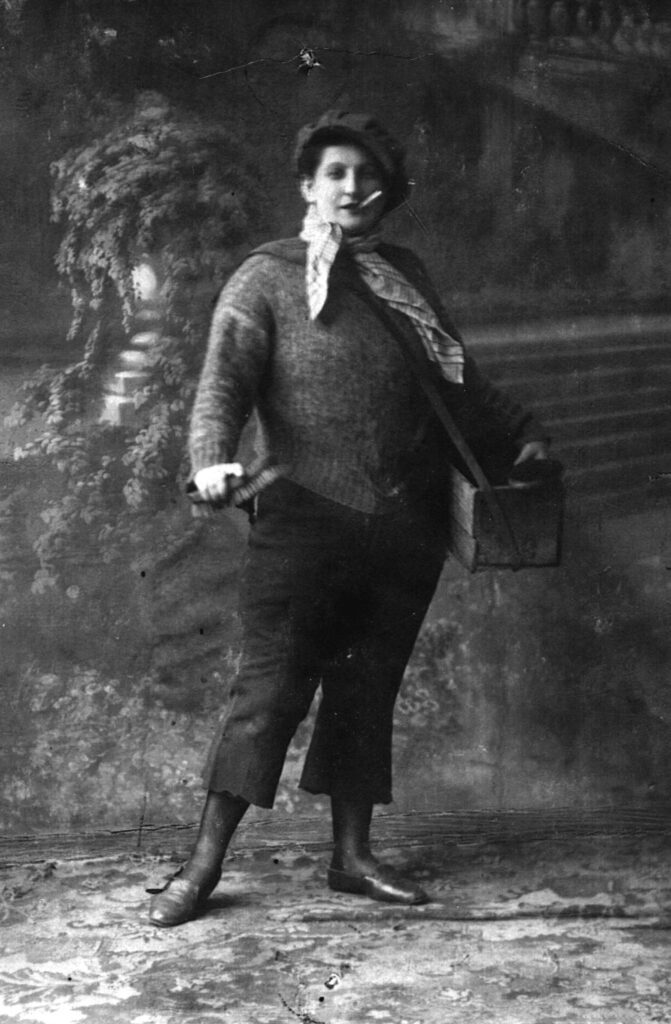
“He steps forward only a little, opens his eyes wide, plucks at his straight black coat with his absent-minded left hand and holds the right out to us, open and large. And we are supposed, even if we are not gripped, to acknowledge that he is gripped and to explain to him how the misfortune, which has been described, was possible (Diaries, January 7, 1912).” Franz Kafka
In this Photo the staged ‘he’ is really a ‘her’ who is of Basia Leibgold a character actress in one of the Yiddish theatres seen by Kafka as mentioned in the following link.
https://web.uwm.edu/yiddish-stage/franz-kafkas-vagabond-stars
The Four Articulations for Performance template of exercises are provided with step-by-step instructions in chapter 2 of the book Clown Secret. It is available in 2 minutes via Kindle, or via online booksellers as a print-on-demand posted to you.
Have a look at my website including the page on “I.S.A.A.C. Creative Mentorship“.
Here is the Blog of 100 blogs https://iraseid.com/2025/11/ira-seidenstein-blog-of-100-blogs-title-with-each-link-i-s-a-a-c.html